
Petr achieved a 10th-place finish at Pro Tour Lorwyn Eclipsed, and he did it with an old faithful.
Hello, everyone! I’m back from Pro Tour Lorwyn Eclipsed, and I managed to achieve a 10th-place finish. Today, I’ll be bringing you a mini-tournament report of the recent Pro Tour and a walkthrough on how to play Dimir Midrange in Standard Constructed. For those who don’t know me, I was a full-time professional Magic: The Gathering player.
Before the Lockdown Era, I achieved four Grand Prix wins (with nine of those including a Top 8 finish) along with three Top 16 Pro Tour finishes. Even though I had to take a step back due to life getting in the way, nothing beats the excitement of travelling around the world, trying to outcompete other players who share the same passion. I admit I’m a bit rusty, but I managed to qualify for the recent Pro Tour with a Top 32 finish at the recent Regional Championship in Antwerp, playing Boros Energy.
After Magic World Championship 31, the Standard metagame began to settle. I tried out the top-performing decks, and the ones I was winning the most with were Dimir Midrange and Izzet Lessons. Eventually, I settled for Dimir Midrange, as I thought that Izzet Lessons would have a huge target on its back while Dimir Midrange would fly under the radar, giving me a great deal of equity. This feels crazy to me — Dimir Midrange used to be one of the most dominant roleplayers in Standard and performed well in various Magic Online Challenges, and yet, no one was taking it seriously going into the Pro Tour. Dimir is historically my favorite color combination in Magic — it’s a style of a deck that I can play at a particularly high level, and my opponents aren’t always fully prepared for how to play against it.
I felt fortunate with my deck choice as the Badgermole Cub matchups (Simic Rhythm and Bant Airbending) were slightly favorable once you’ve played a few matches, and you had a decent matchup against all the slower Elemental decks that were trying to prey on the Cub. Not only that, but these decks (in theory) were also accidentally preying on Izzet Lessons (mainly due to Wistfulness), which was the matchup I dreaded the most.
The Card Choices in Dimir Midrange
Market Price: $19.52
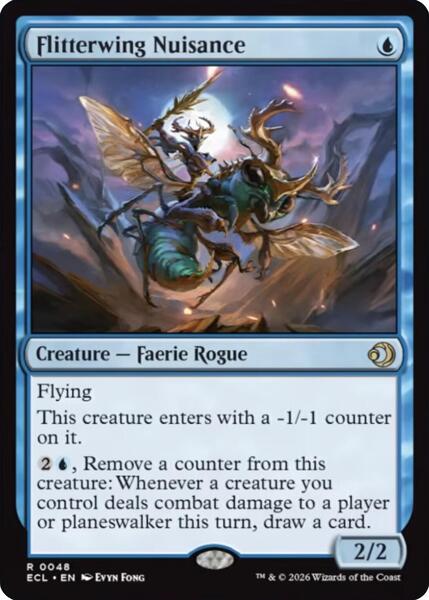
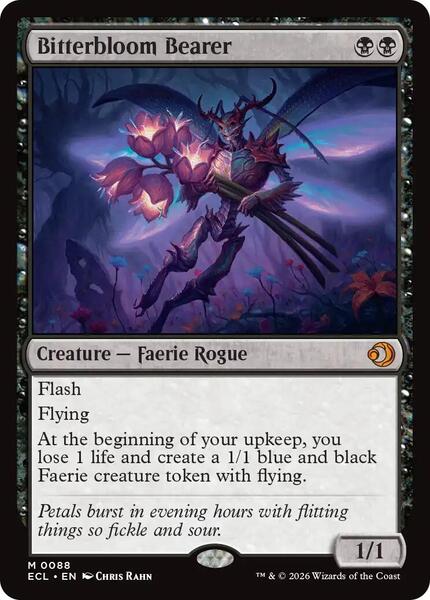
With Lorwyn Eclipsed’s release, I did try the various Faerie cards in Bitterbloom Bearer and Flitterwing Nuisance, but wasn’t impressed with either. While Flitterwing Nuisance reads as an exciting card, it’s basically a one-mana flier with an activation that doesn’t come up often. At first, I thought it might be a suitable replacement for Cecil, Dark Knight or Enduring Curiosity to promote more flexibility. It seemed nice in theory — as you can draw multiple copies of Cecil or perhaps draw into all of your top-end threats, with the one-drop helping those explosive Kaito, Bane of Nightmares draws. After playing with the card, I feel it’s a trap, and you’re better off not running it.The issue with Bitterbloom Bearer, however, is the double-black mana cost. I believe the effect is comparable to Floodpits Drowner, but the mana commitments are too demanding for it to work in Dimir Midrange. You’d have to cut Fountainport or Soulstone Sanctuary, which I believe to be quite important in Dimir Midrange, and you would have to play extra copies of Multiversal Passage and Starting Town instead. Not to mention, the loss of life from the Bearer can cause tension in games, so I believe that it’s better not to play it.
Kaito, Bane of Nightmares
Duskmourn: House of Horror, Mythic

I’ve also seen a few lists playing only three Kaito, Bane of Nightmares, which I don’t really understand. Kaito is by far and away the best card in the deck, and would play more if I could. The card just does everything — it’s hard to deal with, can answer opposing creatures, pushes through damage, and gives you card advantage for just three mana? There are so many decks in Standard right now that immediately fold to a turn-three Kaito, I don’t know what else to tell you.
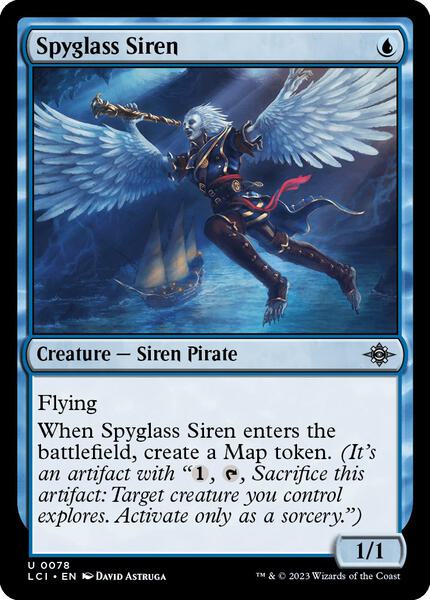
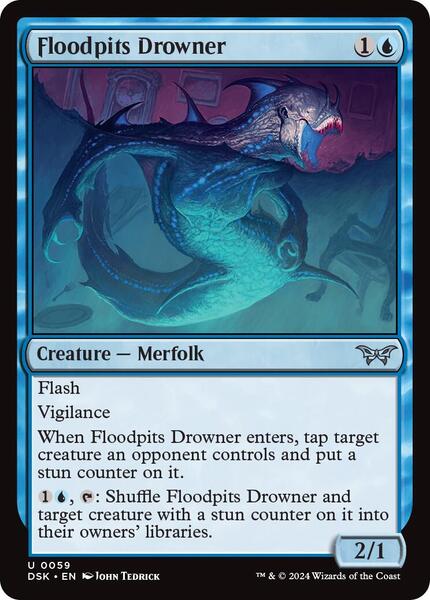
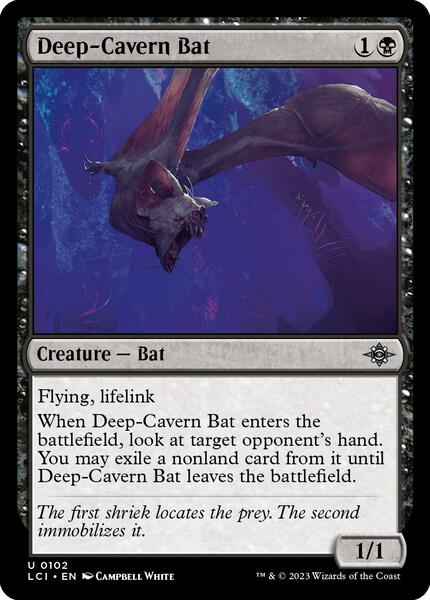

Spyglass Siren, Floodpits Drowner, Deep-Cavern Bat, and Cecil, Dark Knight are your setup creatures to help enable Kaito, Bane of Nightmares and Enduring Curiosity. This is usually your plan for game one, as you have to play proactively since you may not know what you’re playing against until the match has started. If you end up overcorrecting your deck with permission and removal spells instead of these creatures, you then run the risk of drawing these at the incorrect time (such as drawing Spell Snare against Sultai Reanimator).
In post-board games, you can pivot into a more controlling role that plays Kaito and Enduring Curiosity as a way to fuel your hand, while Spyglass Siren may end up being too weak. If you keep these small creatures in the post-board games, then you’re running the risk of a low-powered draw with an unfavorable ratio of spells.
There is a world where I could see myself playing three Deep-Cavern Bat instead of four, as the second copy can be pretty bad, and this is because some archetypes can empty their hands pretty quickly and make the Bat a redundant draw. You could play more copies of Cecil as a replacement, but I anticipated slower decks going into the Pro Tour, which is why I played the full four copies.
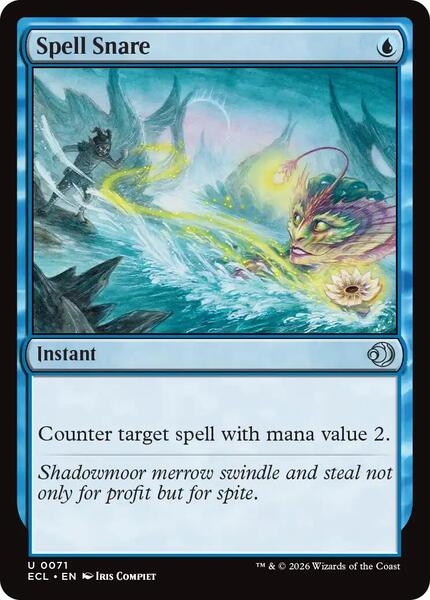
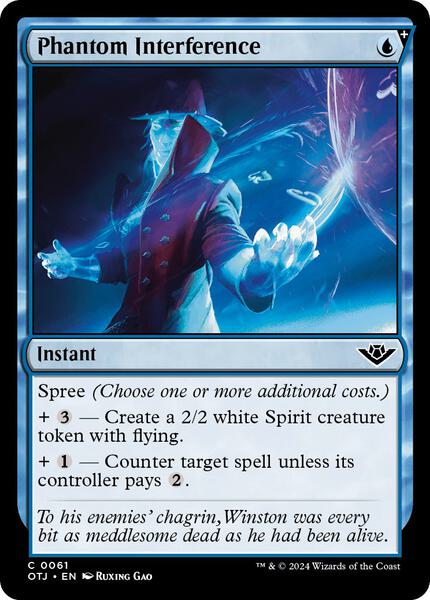
Spell Snare saw a lot of attention post-Lorwyn Eclipsed’s release, and I believe there’s recency bias with the card’s impact in other formats, such as Modern Constructed. Honestly, I don’t like Spell Snare that much — it can be awkward because you have to keep mana open in a Standard format with so many differently-costed spells. It is the perfect answer to Badgermole Cub, however, so I was happy running it as a one-off. Phantom Interference is a catch-all option and comes with a great deal of value. It’s not particularly exciting, but it functions against decks that require an answer for top-end spells (such as Jeskai Relevation) while keeping these archetypes honest in an open-decklist event.
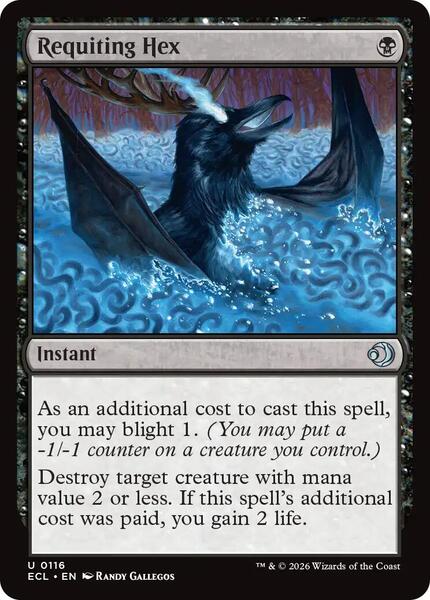
The removal suite in Dimir Midrange is always up for debate, with the printing of Requiting Hex further adding to the discussion. It seems most Dimir Midrange players assumed Requiting Hex would be an auto-include, since it safely answers Badgermole Cub. The issue is that it’s a dead card in several matchups, and Dimir Midrange is also a synergistic deck. Your copies of Kaito and Enduring Curiosity will become marginally worse with every small creature that you remove from the deck.
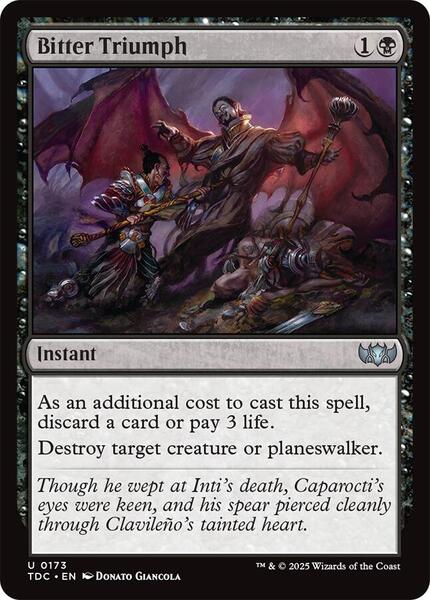
The one-off Bitter Triumph may seem odd, as there aren’t that many Planeswalkers knocking about outside of opposing copies of Kaito, but I wanted two pieces of removal just in case, which freed up a slot in my sideboard as a result. This is actually a concept I use a lot in deckbuilding that I don’t think that many people are aware of these days. When it comes down to Magic, all that matters is your overall win percentage against the expected metagame, which sometimes means you’ll play a card that may be slightly worse than other options, as it allows you to have a better deck. This doesn’t happen frequently, but sometimes the additional sideboard card is actually important, and it adds more of a win percentage as a result. With the other one-offs, I do think Preacher of the Schism is a little clunky and can be awkward at times, but it can become a powerful proactive play on turn three. However, it’s the kind of card you really don’t want to draw multiples of.
Market Price: $12.20
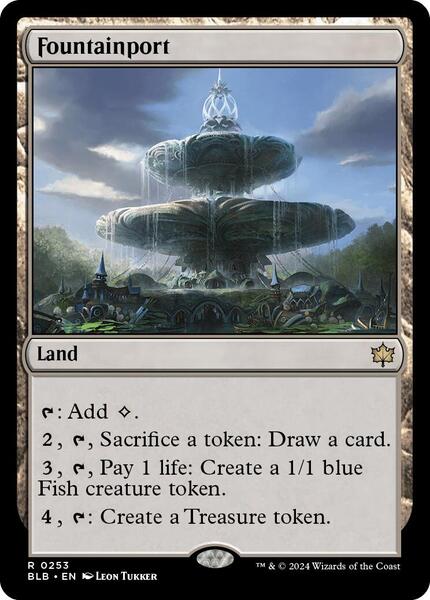
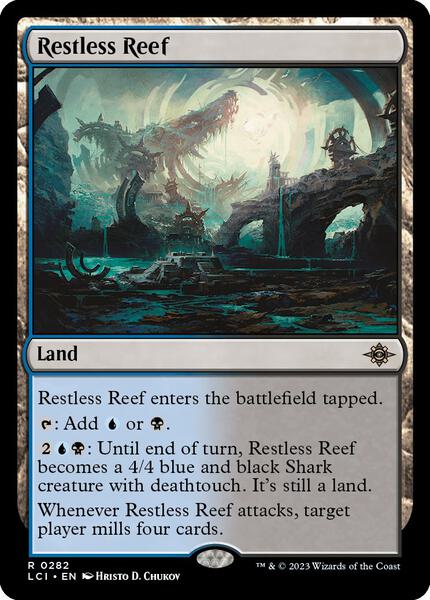
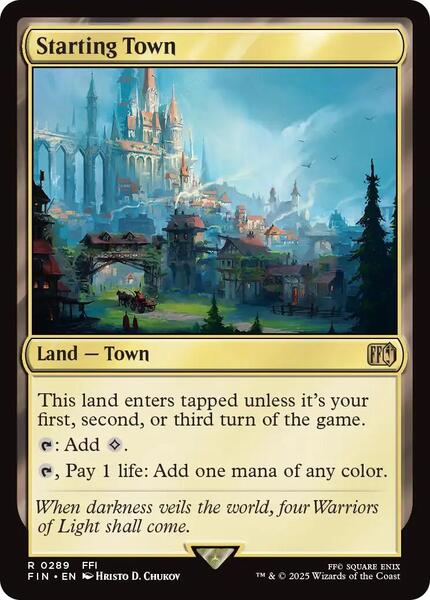
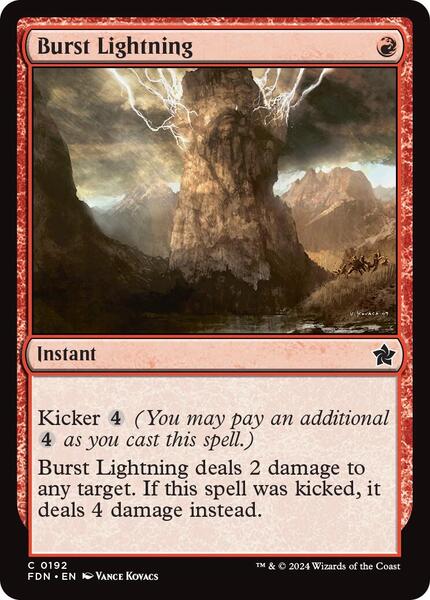
As for the mana base, there are a few interesting points with Dimir Midrange’s mana options at present. Let’s begin with the utility suite, and after playing with all the possible combinations, I am almost certain it is correct to play one Fountainport, two Restless Reef, and two Soulstone Sanctuary — barring some extreme circumstances where the metagame becomes a slugfest. Second, knowing the number of basic Island and Swamp to play can be quite interesting, as you have a double-blue card in Enduring Curiosity, but on the other hand, Gloomlake Verge can’t generate black mana on turn one. This is often crucial when you want to cast Requiting Hex on an opposing Llanowar Elves or Gran-Gran. I currently play more Islands than Swamps because of Enduring Curiosity’s mana demands, but I’m not quite sure what the best configuration is right now.
However, I do believe the first copy of Starting Town is a hard lock, and it’s something you don’t want to draw multiples of. More copies of Multiversal Passage is a possibility, as you have to respect your life total against the various Landfall and Mono-Red Aggro archetypes. For the Pro Tour, I ended up playing only two copies, but going forward, I would probably play three and cut the fifth Island.
Standard Dimir Midrange Sideboard Guide

Market Price: $10.23
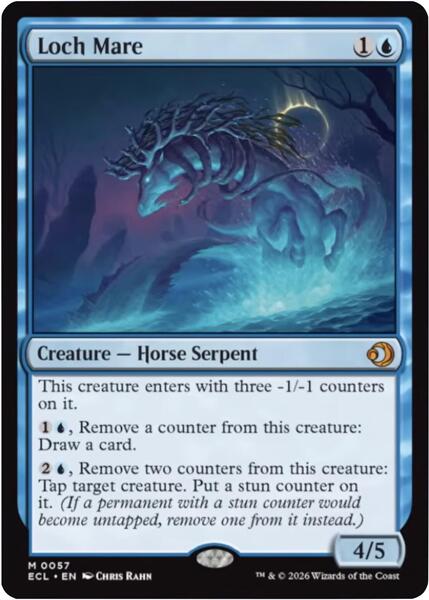
Sideboarding with Dimir Midrange is extremely difficult, as even a small change can decide the outcome of the game. Sometimes, you keep in too many low-powered creatures, and you draw a hand with Kaito and Enduring Curiosity, and then you lose. On the other hand, you can also draw a hand with cards like a Floodpits Drowner, Deep-Cavern Bat, Spyglass Siren, various removal spells, become mana flooded, and then you lose. So, identifying your role, what the matchup is about, and how to evaluate the strength of any certain card you keep in is extremely difficult and requires you to play the deck for a long time.
Vs. Simic Rhythm

Market Price: $52.96
Market Price: $12.18
The first three rounds of Constructed at Pro Tour Lorwyn Eclipsed were a real test for me, as I played against Simic Rhythm in each round. I defeated all three of them, which raised my confidence throughout the event. Below is how I generally sideboard against Simic Rhythm, but do note that you have to adjust sideboarding depending on your opponent’s list and how you expect them to sideboard.
In:
- 2 Disdainful Stroke
- 1 Essence Scatter
- 1 Requiting Hex
- 1 Bitter Triumph
- 1 Loch Mare
- 1 Tragic Trajectory
- 1 Day of Black Sun (on the draw)
Out (on the play):
- 1 Deep-Cavern Bat
- 1 Spell Snare
- 1 Phantom Interference
- 3 Spyglass Siren
- 1 Floodpits Drowner
Out (on the draw):
- 1 Island
- 1 Deep-Cavern Bat
- 1 Phantom Interference
- 3 Floodpits Drowner
- 1 Kaito, Bane of Nightmares
- 1 Spyglass Siren
On the play, you need several ways create momentum, and the most important thing is to have enough power to take advantage of being on the play (this applies not only to this deck but in general Magic strategy) — there is nothing worse than being on the play and drawing only low-impact cards and removal spells to only lose. So, I keep the powerful cards on the play in most matchups (Kaito, Bane of Nightmares, Enduring Curiosity, Tishana’s Tidebinder, and Preacher of the Schism), and I am cutting a bunch of Spyglass Sirens. Yes, Siren can be good, but you are running into an unnecessary risk by keeping them in. On the draw, you are working with more resources than your opponent, but you are lacking momentum, so having additional cheap cards that allow you to use your mana on turn one or double-spell is much more valuable.
Vs. Mono-Green Landfall
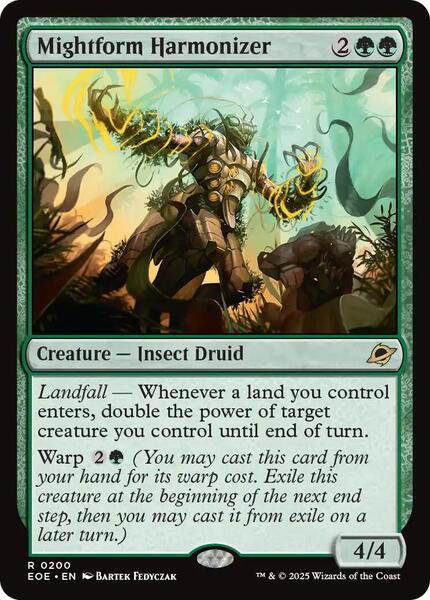
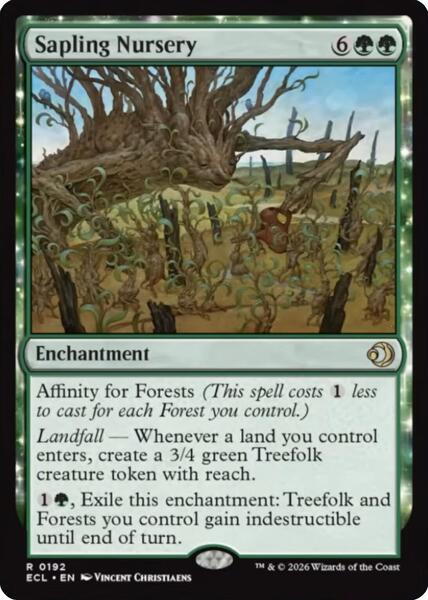
The same logic that I explained before applies to Mono-Green Landfall — the main thing I am unsure about is if you should bring in the Spell Pierce, as it can be dead in some games. Whether you want the Day of Black Sun on the draw (it can be good against Sapling Nursery), and if you want all four copies of Requiting Hex on the play, because sometimes they can draw their deck in a way where Hex doesn’t actually do anything.
In:
- 1 Tragic Trajectory
- 1 Bitter Triumph
- 2 Disdainful Stroke
- 1 Essence Scatter
- 1 Loch Mare
- 1 Annul
- 1 Spell Pierce
- 1 Requiting Hex
Out (on the draw):
- 1 Island
- 1 Phantom Interference
- 1 Kaito, Bane of Nightmares
- 2 Spyglass Siren
- 1 Deep-Cavern Bat
- 1 Floodpits Drowner
- 1 Preacher of the Schism
- 1 Tishana’s Tidebinder
Out (on the play):
- 1 Spell Snare
- 1 Phantom Interference
- 1 Cecil, Dark Knight
- 1 Deep-Cavern Bat
- 3 Spyglass Siren
- 1 Floodpits Drowner
- 3 Spyglass Siren
That said, an extra copy of Floodpits Drowner may be nice here to create momentum against the Landfall payoffs. For round seven at the Pro Tour, I was called to the feature match and played against Mono-Green Landfall. If you want to see how Dimir Midrange plays out against the deck, feel free to watch below.https://www.youtube.com/embed/IVArPV2SfNs?si=AsKJzCGXJHvvkg7Z
The scary thing about Mono-Green Landfall is how it can attack from so many different angles. You need to remove their early threats in Llanowar Elves and company, but you also need to prevent them from going over the top with cards like Sapling Nursery and Mightform Harmonizer. When it comes to Magic strategy, all of your decisions come down to the equity of the decision to win a game compared to the other options.
Vs. Izzet Spellementals
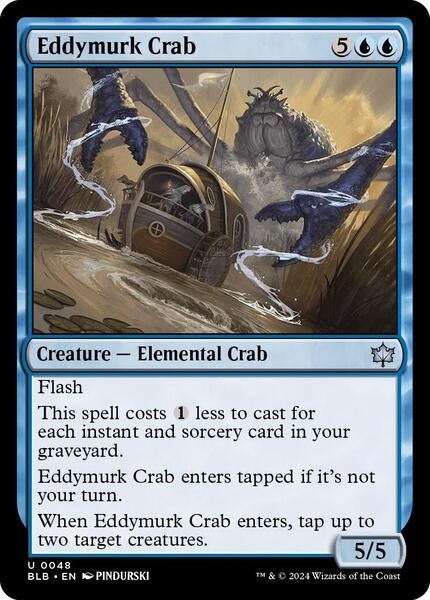
With Izzet Spellementals, do note that I didn’t board out a land on the draw here because the deck often bounces your creatures. Sometimes you may want to play a draw-go game instead, which means you’ll always have cards in your hand, so having extra lands is valuable here.
In:
- 2 Disdainful Stroke
- 1 Essence Scatter
- 1 Strategic Betrayal
- 2 Soul-Guide Lantern
- 1 Loch Mare
- 1 Bitter Triumph
- 1 Tragic Trajectory
- 1 The Unagi of Kyoshi Island
Out:
- 3 Requiting Hex
- 1 Spell Snare
- 1 Phantom Interference
- 1 Preacher of the Schism
- 2 Deep-Cavern Bat
- 2 Tishana’s Tidebinder
It’s debatable whether you want to keep Preacher of the Schism on the play, but it’s going to be an expensive card that feeds right into their plan. In a good matchups where your strategy lines up really well against theirs, you should cut all situational cards that are asking for potential trouble — such as Preacher of the Schism, Spell Snare, Spell Pierce, Duress, or Phantom Interference. These cards can be good, but there are many situations where they aren’t. I believe it’s better to avoid taking that risk, as the other options are going to perform better in most games.
Vs. Dimir Excruciator

Market Price: $10.46
I felt pretty good going into Day 2 of the Pro Tour, after finishing 5-0 in Constructed on Day 1. The fight was not over, as I still had another day of Magic ahead of me where I needed to go 4-4 to qualify for the next Pro Tour. Day 2 started with an easy victory against Izzet Spellementals, then I was up against Dimir Excruciator at the hands of the eventual champion, Christoffer Larsen. Chris and I go way back, as we’re former teammates back on the old European Grand Prix circuit. Chris was playing one of the breakout decks in Dimir Excruciator, which was another great matchup for me.
In:
- 1 Loch Mare
- 2 Disdainful Stroke
- 1 Essence Scatter
- 1 The Unagi of Kyoshi Island
- 1 Duress (on the draw)
Out:
- 1 Spell Snare
- 3 Requiting Hex
- 1 Bitter Triumph
- 1 Island (on the draw)
- 2 Shoot the Sheriff (on the play)
The key thing to note here is that I don’t actually think that you need removal or graveyard hate against Dimir Excruciator. They aren’t a traditional Reanimator-style deck, but more of a controlling one. Your role in the matchup is to go under them and get ahead with a Kaito or Enduring Curiosity. Having Kaito, Loch Mare, Floodpits Drowner, and countermagic is enough to combat their creatures. I believe that having removal spells or “do nothing” cards (like Soul-Guide Lantern) is a way to lose. They can get ahead on cards easily or discard (with Deceit) your action cards twice, so having reactive cards isn’t as good in this matchup.
Vs. Four/Five-Color Elementals

Market Price: $59.83

Market Price: $46.95
The next round was against Four-Color Elementals with Cavern of Souls, Ashling, Rekindled, and a bunch of top-end threats. This matchup also feels great, as you have a suite of solid answers for their two-mana enablers and their deck often doesn’t really do anything without them.
In:
- 1 Loch Mare
- 1 Strategic Betrayal
- 1 Tragic Trajectory
- 1 Bitter Triumph
Out:
- 1 Phantom Interference
- 1 Spell Snare
- 2 Requiting Hex
The most problematic card is Roaming Throne because it’s hard to remove and it blanks your copies of Tishana’s Tidebinder. You also cannot really afford to have countermagic for the Throne-postboard because of Cavern of Souls, so I was wishing that I had more copies of Strategic Betrayal available instead.
Vs. Izzet Blink
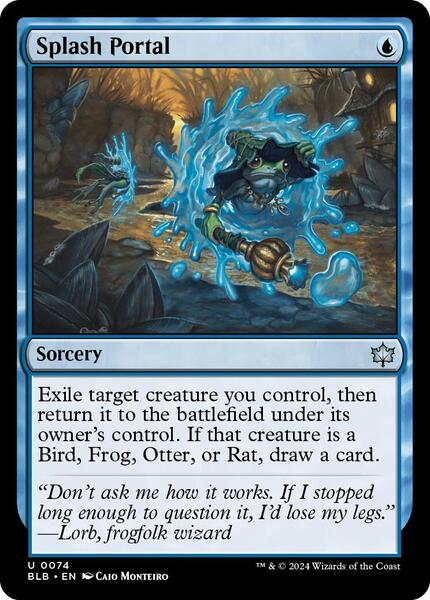
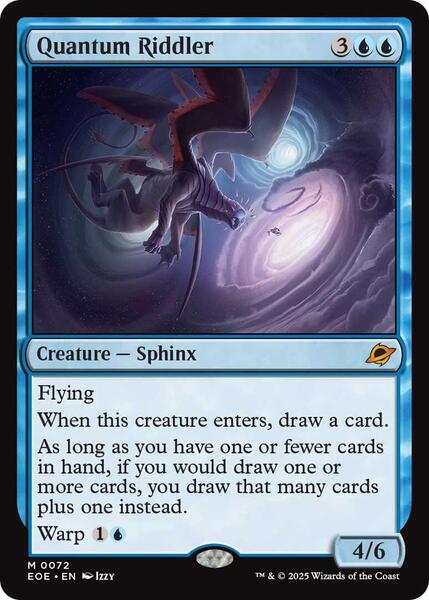
Market Price: $38.34
The pairings for the final round at the Pro Tour went up, and a nightmare scenario happened — I was paired against Arne Huschenbeth. Not only is Arne one of the best active players going, but he is also someone I fear the most, as he already beat me in the finals of a Grand Prix once. Arne was on Izzet Blink, and once again, I feel I am favored in the matchup.
In:
- 1 Bitter Triumph
- 1 Annul
- 1 Loch Mare
- 2 Disdainful Stroke
- 1 Essence Scatter
- 1 The Unagi of Kyoshi Island
- 1 Spell Pierce (on the play or 1 Duress on the draw)
Out:
- 3 Floodpits Drowner
- 1 Deep-Cavern Bat
- 1 Phantom Interference
- 1 Spyglass Siren
- 1 Preacher (on the draw)
- 1 Island (on the draw)
- 1 Hex (on the play)
- 1 Spell Snare (on the play)
Izzet Blink has a hard time beating Kaito, though I definitely think it’s close as they can go under you with Stormchaser’s Talent and then attack from a few different angles. All of your cards are independently good, so you need to find the right mix to keep the deck balanced. I believe that Floodpits Drowner is generally bad against them as it lines up poorly against the random Otter tokens they’re packing, but I still like to keep the one on the mainboard. By the way, a cool interaction I haven’t mentioned yet is that you can activate the Floodpits Drowner’s ability when unblocked and, in response, bounce it with Kaito for an extra value.
After that match, I couldn’t believe I made it! Before the Top 8 announcement, each player with a 12-4 record was asked to go backstage in case they made it. However, Marco Cammiluzzi and I knew it was us in 9th and 10th, which is what ended up happening anyway. Christoffer Larsen happened to squeak in at 8th, who ended up winning Pro Tour Lorwyn Eclipsed.
Vs. Izzet Lessons

Market Price: $19.56
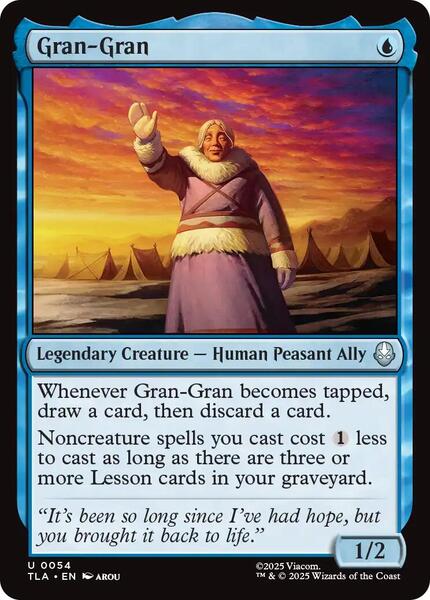

Rounding things out, I admit I haven’t faced the Izzet Lessons matchup with Dimir Midrange yet, but it’s worth respecting given its rise in popularity.
In:
- 1 Annul
- 2 Soul-Guide Lantern
- 1 Bitter Triumph
- 1 Duress
- 1 Spell Pierce
- 1 The Unagi of Kyoshi Island
- 1 Loch Mare
Out:
- 4 Floodpits Drowner
- 1 Phantom Interference
- 2 Shoot the Sheriff
- 1 Tishana’s Tidebinder
The key problem of sideboarding against Izzet Lessons is that you have to remove Gran-Gran as soon as possible, but if they don’t have it, your removal lines up quite poorly. I don’t think Strategic Betrayal is good enough against Izzet Lessons, as it’s easy for them to rebuild their graveyard with more Lesson cards, so it becomes a two-mana sorcery-speed edict. I expect Izzet Lessons to remain popular long after the Pro Tour, so I would consider adding an extra Negate and Annul to the sideboard over a Day of Black Sun and a Disdainful Stroke. I would also consider adding another Multiversal Passage over an Island if you anticipate a lot of Izzet Lessons in your local metagame.